
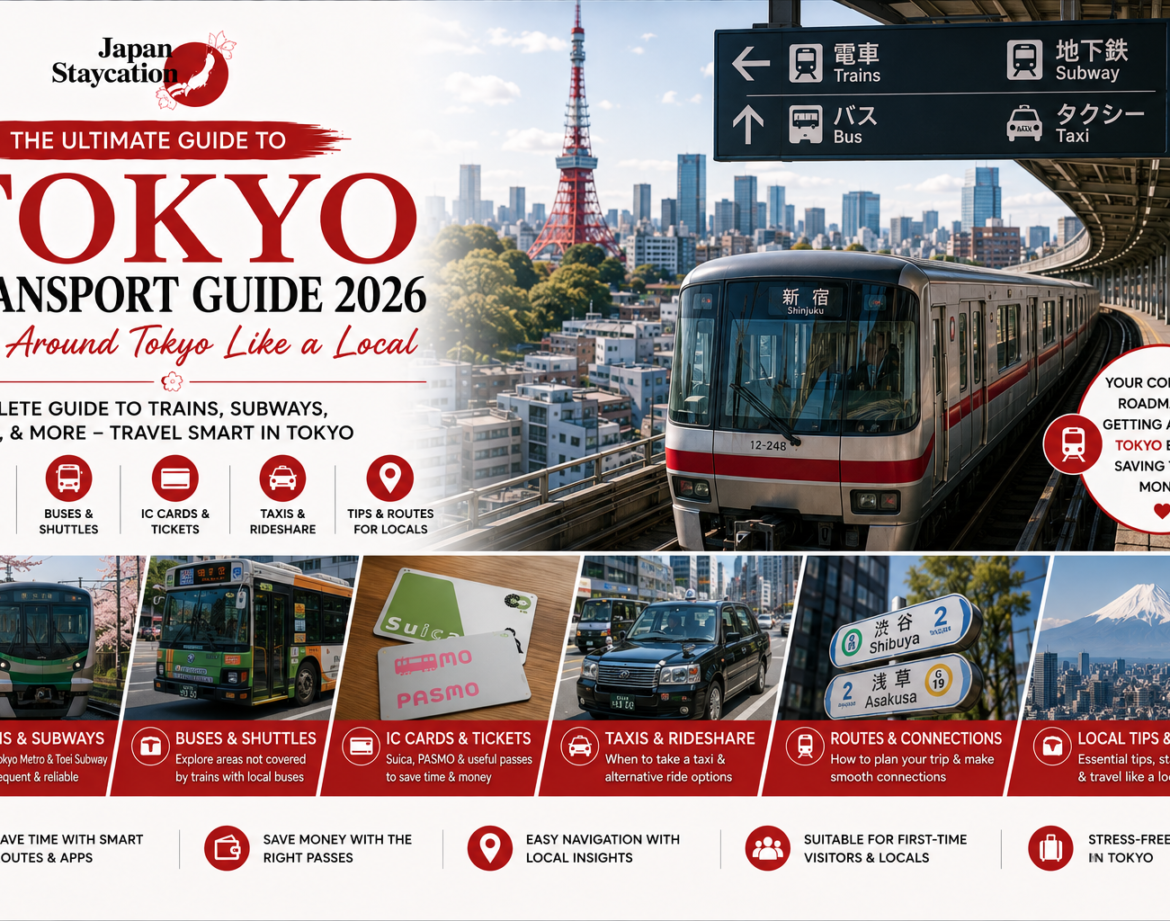
Tokyo Transport Guide 2026: How to Get Around Like a Local
Tokyo Transport Guide 2026: How to Get Around Like a Local
Navigating Tokyo’s transportation system is essential for any staycation. With over 13 million residents and a metropolitan area of 37 million, Tokyo has built one of the world’s most efficient — and complex — public transport networks. This guide breaks down everything you need to know to get around Tokyo confidently in 2026.
Tokyo Transport Overview
Tokyo’s transport system consists of:
- JR East (Japan Railways): Yamanote Line, Chuo Line, Keihin-Tohoku Line
- Tokyo Metro: 9 subway lines covering central Tokyo
- Toei Subway: 4 additional subway lines
- Private Railways: Odakyu, Keio, Seibu, Tobu (for outer areas)
- Buses: Covering areas trains don’t reach
- Taxis and Rideshares: Uber (limited), Go Taxi, DiDi
Key Fact: The Yamanote Line (JR) loops around central Tokyo, connecting all major districts including Shibuya, Shinjuku, Ueno, Tokyo Station, and Shinagawa.
IC Cards: Your Transport Passport
Suica and Pasmo (2026 Update)
Starting in 2026, Suica and Pasmo IC cards are available in smartphone digital wallet versions, eliminating the need for physical cards.
| Card Type | Best For | Where to Get |
|---|---|---|
| Suica (Apple Wallet) | iPhone users | Add directly in Apple Wallet |
| Pasmo (Google Wallet) | Android users | Google Pay app |
| Welcome Suica | Tourists (no deposit) | Major stations, airports |
| Physical Suica | Backup option | JR East ticket machines |
2026 Pricing:
– Regular Suica/Pasmo: ¥500 deposit + minimum ¥1,000 charge
– Welcome Suica (tourist): ¥1,000-¥10,000 pre-loaded, no deposit
How IC Cards Work
- Tap in at station gates (entry)
- Tap out at destination (exit)
- Fares automatically deducted
- Works on trains, buses, subways, and even convenience stores
JR Pass 2026: Is It Worth It for Tokyo Staycations?
The Short Answer
For Tokyo-only staycations: Usually NOT worth it
For Tokyo + day trips (Nikko, Hakone, Kamakura): Consider it
JR Pass Pricing (2026 Estimates)
| Duration | Price (Adult) | Price (Child) |
|---|---|---|
| 7 Days | ¥50,000 ($335) | ¥25,000 ($168) |
| 14 Days | ¥80,000 ($536) | ¥40,000 ($268) |
| 21 Days | ¥100,000 ($670) | ¥50,000 ($335) |
When JR Pass Makes Sense
Consider purchasing if your staycation includes:
– Day trip to Nikko (¥5,000 round trip)
– Day trip to Kamakura (¥1,800 round trip)
– Airport transfer via Narita Express (¥3,000 one way)
– Multiple Shinkansen rides
Break-even: Approximately 3-4 long-distance JR trips
When to Skip the JR Pass
For Tokyo-only exploration:
– Individual tickets are cheaper
– Tokyo Metro/Toei subway lines are NOT covered by JR Pass
– Most Tokyo attractions are accessible by non-JR lines
Understanding Tokyo Metro and Subway
Tokyo Metro (9 Lines)
| Line | Color | Key Stations | Best For |
|---|---|---|---|
| Ginza | Orange | Shibuya, Ginza, Asakusa | Shopping, temples |
| Marunouchi | Red | Shinjuku, Tokyo Station, Ginza | Central Tokyo |
| Hibiya | Silver | Roppongi, Ginza, Ueno | Nightlife, museums |
| Tozai | Sky Blue | Nakano, Otemachi, Toyosu | Cross-town east-west |
| Chiyoda | Green | Omotesando, Akihabara | Fashion, electronics |
| Yurakucho | Gold | Ikebukuro, Ginza, Shin-Kiba | Entertainment |
| Hanzomon | Purple | Shibuya, Omotesando, Tokyo Skytree | Trendy areas |
| Namboku | Teal | Meguro, Roppongi, Akabane | Residential areas |
| Fukutoshin | Brown | Shibuya, Ikebukuro | West Tokyo |
Toei Subway (4 Lines)
| Line | Color | Key Stations | Best For |
|---|---|---|---|
| Asakusa | Pink | Asakusa, Nihonbashi, Shimbashi | Traditional Tokyo |
| Mita | Blue | Meguro, Otemachi, Sugamo | Business districts |
| Shinjuku | Leaf Green | Shinjuku, Jimbocho, Bakuro-Yokoyama | Budget hotels |
| Oedo | Magenta | Roppongi, Tsukiji, Tocho-Mae | Tsukiji Market |
Airport Transfers
From Narita Airport (NRT)
| Option | Time | Cost | Best For |
|---|---|---|---|
| Narita Express (N’EX) | 60 min | ¥3,070 | JR Pass holders |
| Skyliner | 41 min | ¥2,470 | Fastest option |
| Airport Limousine Bus | 90 min | ¥3,100 | Direct to hotels |
| Keisei Access Express | 70 min | ¥1,270 | Budget option |
| Taxi/Uber | 60 min | ¥30,000+ | Groups/lots of luggage |
Staycation Tip: If arriving late evening, pre-book a pocket WiFi or eSIM at the airport. Google Maps is essential for navigating Tokyo transport.
From Haneda Airport (HND)
| Option | Time | Cost | Best For |
|---|---|---|---|
| Tokyo Monorail | 20 min | ¥500 | Budget, scenic |
| Keikyu Line | 15 min | ¥300 | Fastest, cheapest |
| Airport Bus | 30-60 min | ¥1,000 | Direct to hotels |
| Taxi | 20-40 min | ¥6,000-10,000 | Convenience |
Staycation Tip: Haneda is closer to central Tokyo — if your flight options are equal, choose Haneda for easier access.
Essential Transport Apps
Must-Have Apps for Tokyo
| App | Purpose | English? | Cost |
|---|---|---|---|
| Google Maps | Navigation, routes | Yes | Free |
| Hyperdia | Train schedules, fares | Yes | Free |
| JapanTransit | Route planning | Yes | Free |
| Suica/Pasmo | Digital IC card | Limited | Free |
| Go Taxi | Taxi hailing | Yes | Free (pay per ride) |
Pro Tips for Using Apps
- Download offline maps before arriving (spotty WiFi in stations)
- Screenshot your route before entering stations
- Hyperdia is more accurate than Google Maps for train schedules
- Google Maps shows real-time departure boards at stations
Transport Costs: Budget Breakdown
Daily Transport Budget
| Staycation Type | Daily Transport Cost | Notes |
|---|---|---|
| Budget | ¥800-1,200 ($5-8) | IC card, stay central |
| Mid-Range | ¥1,500-2,500 ($10-17) | Mix of trains, occasional taxi |
| Luxury | ¥3,000+ ($20+) | Taxis, airport transfers |
7-Day Transport Pass Comparison
| Pass | Cost | Coverage | Best For |
|---|---|---|---|
| Tokyo Metro 72-Hour Ticket | ¥1,500 | Metro only | Central Tokyo |
| Tokyo Subway Ticket (24h) | ¥800 | Metro + Toei | Day-tripping |
| Tokyo Subway Ticket (72h) | ¥1,500 | Metro + Toei | Short staycations |
| JR Tokyo Wide Pass | ¥10,180 | JR in Tokyo + surrounds | Day trips |
| Suica/Pasmo Pay-as-you-go | Variable | All transport | Flexibility |
Accessibility in Tokyo Transport
Tokyo has improved accessibility significantly:
- Elevators: All major stations have elevators (follow green signs)
- Priority seating: Marked seats on all trains
- Women-only cars: Available during rush hour (marked with pink signs)
- Step-free access: Most major stations and modern rental buildings
- Audio guidance: Many stations have English announcements
Staycation Tip: When booking rentals, confirm if the building has elevator access — many older Tokyo apartments only have stairs.
Late-Night Transport
Tokyo’s trains stop running around midnight and resume at 5 AM.
Late-Night Options
| Time | Options | Cost |
|---|---|---|
| Until midnight | Last trains | Regular fare |
| 12 AM – 5 AM | Taxis, Uber, night buses | ¥3,000-10,000 |
| After 5 AM | First trains | Regular fare |
Staycation Tip: If planning late-night activities in Roppongi or Shibuya, budget for a taxi home or choose a rental within walking distance.
Transport Etiquette: Do’s and Don’ts
Do:
- Stand on the left side of escalators (Tokyo standard)
- Let passengers exit before entering
- Keep phones on silent mode in trains
- Offer priority seats to elderly, pregnant, or injured passengers
- Queue neatly at platform markings
Don’t:
- Talk loudly on trains (whisper if necessary)
- Eat or drink on trains (except long-distance)
- Block doors when boarding
- Rush — trains run every 2-3 minutes during peak hours
Staycation Neighborhoods by Transport Access
| Neighborhood | Best Station | Lines | Airport Access |
|---|---|---|---|
| Shibuya | Shibuya Station | JR Yamanote, Metro Ginza/Hanzomon | Haneda: 40 min |
| Shinjuku | Shinjuku Station | JR + 4 Metro lines | Haneda: 45 min |
| Ginza | Ginza Station | Metro Marunouchi/Hibiya | Haneda: 35 min |
| Asakusa | Asakusa Station | Metro Ginza/Toei Asakusa | Haneda: 50 min |
| Ueno | Ueno Station | JR Yamanote + Metro | Narita: 45 min (Keisei) |
| Akihabara | Akihabara Station | JR Yamanote + Metro | Haneda: 40 min |
| Roppongi | Roppongi Station | Metro Hibiya/Oedo | Haneda: 30 min |
Conclusion: Master Tokyo Transport for the Perfect Staycation
Tokyo’s transport system is intimidating at first but becomes intuitive quickly. Start with an IC card, download Google Maps, and stick to the Yamanote Line for your first few days.
The key to a smooth staycation: Choose a rental near a major station (Yamanote Line priority) and avoid rush hours (7:30-9 AM, 5:30-7:30 PM) when possible.
With practice, you’ll navigate Tokyo’s trains as confidently as any local — and the savings on transport costs mean more budget for experiences.
Ready to choose your neighborhood? Explore our complete Tokyo staycation guide with district-by-district rental recommendations.
Pingback: Best Japan Staycations 2026: Complete Guide to Cities, Neighborhoods & Tips – japanstaycation.com