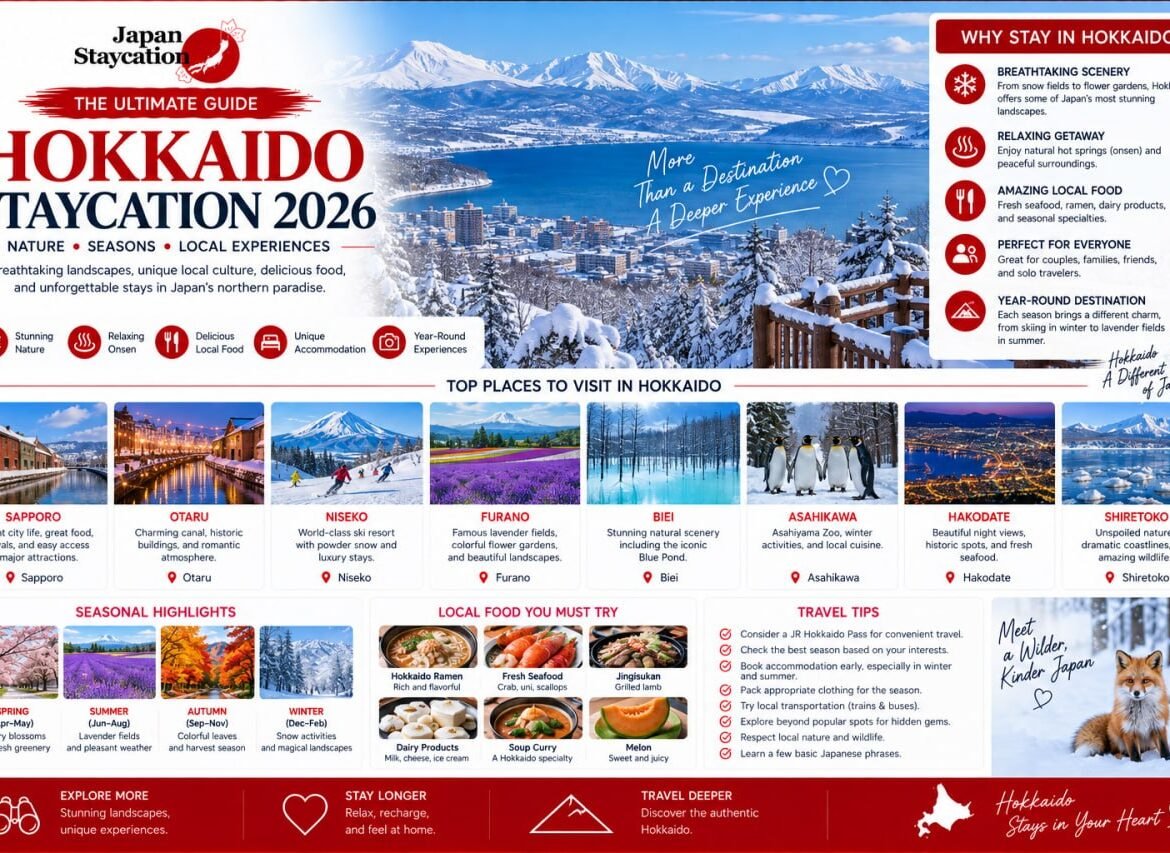
Hokkaido Staycation 2026: Sapporo, Otaru & Niseko Winter Guide
Hokkaido
Staycation 2026: Sapporo, Otaru & Niseko Winter Guide
Hokkaido is Japan’s final frontier—a vast northern island where
wilderness dominates and cities feel like outposts of civilization
rather than centers of it. For a staycation in 2026, Hokkaido offers
something impossible to find elsewhere in Japan: space, silence, and
seasons so dramatic they redefine what winter and summer can mean.
This guide covers the classic Hokkaido triangle for first-time
staycationers: Sapporo as your urban base, Otaru for romantic coastal
charm, and Niseko for some of the world’s finest powder snow. Whether
you visit for winter skiing or summer flower fields, this itinerary
delivers Hokkaido’s greatest hits with practical rental advice and
insider timing.
Why
Hokkaido Is Japan’s Ultimate Staycation Destination
Hokkaido operates on a different frequency from the rest of Japan.
The food is heartier, the people more direct, the landscapes more
dramatic. Summer brings fields of lavender so purple they look painted.
Winter dumps snow so light and dry it feels like skiing through
feathers.
For staycation travelers, Hokkaido offers three advantages that
justify the extra travel time:
Seasonal Extremes: No destination in Japan delivers
such dramatic seasonal transformation. The same mountain trail that
hosts July lavender farms becomes a January powder corridor. You could
visit twice in one year and barely recognize the place.
Affordable Long Stays: Outside peak ski season and
the Snow Festival, Hokkaido vacation rentals are significantly cheaper
than Tokyo or Kyoto equivalents. Monthly discounts are common, making it
ideal for remote work stays.
Accessible Nature: Unlike the Japanese Alps or
remote Tohoku regions, Hokkaido’s wilderness sits close to urban
centers. You can breakfast in a Sapporo cafe, ski Niseko’s backcountry
by lunch, and soak in an onsen by dinner.
Best Areas for
Your Hokkaido Staycation Rental
Sapporo City Center: The
Urban Base
Sapporo is Japan’s fifth-largest city but feels surprisingly
manageable. Built on a grid system (rare for Japanese cities), it is
navigable, walkable, and equipped with everything you need for a
comfortable extended stay.
Vacation rental options: – Susukino district
apartments: Studio and 1-bedroom units in the entertainment district,
walking distance to ramen alleys and nightlife (USD 50-90 per night) –
Odori Park vicinity: Modern apartments with park views, ideal for the
Snow Festival (USD 70-120 per night) – Nakajima Park area: Quieter
residential zone with excellent cafe culture (USD 60-100 per night) –
Sapporo Station vicinity: Ultra-convenient for day trips but slightly
sterile (USD 70-110 per night)
Sapporo’s public transit is excellent. The subway system covers most
neighborhoods, and JR lines connect you to Otaru and Niseko. A central
apartment eliminates the need for car rental if you are comfortable with
trains.
Best for: First-time Hokkaido visitors, food-focused
travelers, urban convenience seekers
Niseko: Powder Paradise
Niseko has evolved from a sleepy farming village into Japan’s premier
international ski destination. The “Niseko United” network of four
interconnected resorts (Grand Hirafu, Hanazono, Niseko Village, and
Annupuri) offers terrain for every level, all fueled by an average of 15
meters of annual snowfall.
Vacation rental options: – Hirafu village
apartments: The main hub with restaurants, bars, and ski-in/ski-out
access (USD 150-400 per night in peak season) – Lower Hirafu and
Kabayama houses: 5-10 minutes from lifts but significantly cheaper (USD
100-250 per night) – Niseko Village condos: Family-friendly with resort
amenities (USD 120-300 per night) – Annupuri and Moiwa: Quieter, more
Japanese-local atmosphere, smaller accommodations (USD 80-180 per
night)
Niseko is expensive by Hokkaido standards, especially
December-February. Consider staying in Kutchan town (10 minutes by car)
for lower prices and a more authentic Japanese town experience.
Best for: Skiers and snowboarders, winter sports
families, powder chasers
Otaru: Canal Romance
This small port city 40 minutes northwest of Sapporo delivers the
romantic Hokkaido experience visitors imagine. The preserved canal
district, historic warehouse buildings, and fresh seafood markets make
it perfect for a 2-3 day extension or a quiet alternative base.
Vacation rental options: – Canal-side guesthouses in
converted warehouses (USD 80-150 per night) – Residential apartments
near the JR station for longer stays (USD 60-100 per night) –
Mountain-view cottages on the city’s edge (USD 70-130 per night)
Otaru works best as a secondary base after Sapporo rather than a
primary staycation location, unless you specifically want a slower-paced
retreat.
Best for: Couples, photographers, seafood
enthusiasts, slow travelers
Furano & Biei: Summer
Flower Fields
If your staycation falls between June and September, consider basing
yourself in the Furano-Biei region, two hours east of Sapporo. Rolling
hills of lavender, sunflowers, and potato flowers create landscapes that
look imported from Tuscany.
Vacation rental options: – Farmstay guesthouses with
half-board meals (USD 80-140 per night) – Self-catering cottages with
mountain views (USD 70-120 per night) – Pension-style lodges with shared
facilities (USD 50-90 per night)
Access is challenging without a car. Rent a vehicle at Asahikawa
Airport or take the train to Furano Station and arrange local
transport.
Best for: Summer visitors, photographers, nature
lovers, families with children
Top Things to
Do During Your Hokkaido Staycation
Winter Activities
(December-March)
Niseko Skiing & Snowboarding: Four
interconnected resorts with English-speaking instruction, equipment
rental, and some of the driest, lightest powder on Earth. Grand Hirafu
has the most infrastructure. Hanazono has the best tree skiing. Annupuri
is least crowded.
Sapporo Snow Festival: Held during one week in early
February, this is Hokkaido’s signature event. Massive snow sculptures
occupy Odori Park, while Susukino hosts an ice sculpture competition.
Book accommodations 6+ months in advance.
Snowshoeing and Backcountry: Niseko’s guided
backcountry tours access untouched powder fields with avalanche safety
equipment provided. For a gentler experience, snowshoe tours around Lake
Toya or the Jozankei onsen area offer forest tranquility.
Onsen Hopping: Hokkaido’s volcanic activity creates
abundant hot springs. Noboribetsu (hell valley), Jozankei (near
Sapporo), and Niseko’s own onsen village provide restorative soaks after
cold days outdoors.
Drift Ice Cruises: From late January to March, the
Sea of Okhotsk freezes solid near Abashiri and Monbetsu. Icebreaker
cruises smash through frozen ocean while Steller’s sea eagles soar
overhead—a surreal experience unavailable elsewhere in Japan.
Summer Activities
(June-September)
Farm Tomita Lavender Fields: The iconic Furano
lavender blooms peak in mid-July, creating purple carpets against
snow-capped mountains. Arrive before 8 AM to beat tour buses.
Biei Patchwork Road: Rent a bicycle or car and
cruise past the famous “Ken & Mary Tree,” “Seven Star Tree,” and
rolling fields that earned this region its “patchwork” nickname.
Lake Toya: A caldera lake so perfectly circular it
looks artificial. Kayak, cycle the lakeside path, or stay overnight for
the nightly summer fireworks display (May-October).
Sapporo Beer Gardens: Summer in Sapporo means
outdoor beer gardens. The historic Sapporo Beer Museum garden and the
Susukino street-side “yatai” stalls create a festive atmosphere that
lasts until midnight.
Shiretoko Peninsula: A UNESCO World Heritage site in
eastern Hokkaido where brown bears roam waterfalls that flow directly
into the ocean. Requires dedicated time but offers Japan’s most pristine
wilderness.
Year-Round Activities
Sapporo Ramen Yokocho: This narrow alley with 17
ramen shops has been serving miso, shio, and shoyu ramen since 1951.
Come hungry, order at the ticket machine, and slurp at the counter.
Nijo Market: Sapporo’s answer to Tokyo’s Tsukiji
offers king crab, sea urchin, and Hokkaido’s famous “kaisendon” (sashimi
rice bowls) starting at USD 15. Morning visits guarantee the freshest
catch.
Otaru Canal: The preserved gas lamps and warehouse
restaurants create an evening atmosphere that feels like Victorian
Hokkaido. Visit the Music Box Museum and sample LeTAO cheesecake while
strolling.
Sapporo Clock Tower & Former Hokkaido Government
Building: Two red-brick American-influenced buildings that seem
transported from New England. Surprisingly interesting museum exhibits
inside.
Hokkaido Food: The Land of
Giants
Hokkaido’s produce grows larger, its dairy richer, and its seafood
fresher than anywhere else in Japan. The island is Japan’s breadbasket,
and its cuisine reflects agricultural abundance.
Must-Try Dishes: – Genghis Khan
(Jingisukan): Lamb grilled on a domed metal pan at the table.
Sapporo specialty available at dedicated restaurants across the city. –
Soup Curry: A Sapporo invention combining curry spices
with clear soup, vegetables, and meat. Soul-warming after cold days. –
Seafood Rice Bowls (Kaisendon): Hokkaido’s proximity to
fishing grounds means sashimi so fresh it practically vibrates. Salmon
roe, sea urchin, and king crab are the holy trinity. – Dairy
Products: Hokkaido milk, cheese, and ice cream are nationally
famous. Try soft-serve at any farm attraction. – Ramen:
Sapporo miso ramen (rich, corn-topped), Asahikawa soy sauce ramen (oily,
complex), and Hakodate salt ramen (clear, delicate). Try all three
styles.
Budget Dining (USD 10-20) – Sapporo Station
underground “Ramen Alley” (Ganso Ramen Yokocho) – Nijo Market kaisendon
stalls – Convenience store onigiri with Hokkaido salmon – University
cafeteria lunch (open to public at Hokkaido University)
Mid-Range Dining (USD 30-60) – Genghis Khan
restaurants (Daruma is the famous chain) – Soup curry specialty shops
(Suage, Garaku) – Izakaya with all-you-can-drink menus
Splurge Experiences (USD 80+) – King crab course
meals at Nijo Market restaurants – Farm-to-table kaiseki in Furano farm
restaurants – Private sushi counter experiences in Sapporo
Getting Around Hokkaido
JR Hokkaido Rail Pass: Essential if you are
traveling between Sapporo, Otaru, Furano, and Hakodate. Purchase before
arrival for significant savings.
Car Rental: Hokkaido’s wide roads and sparse traffic
make driving easier than Honshu. International visitors need an
International Driving Permit (Geneva Convention 1949 version—NOT the
digital IDP). Rent from New Chitose Airport.
Sapporo Subway: Three lines covering the city
center. Efficient for daily urban transport.
Resort Shuttles: Niseko runs extensive shuttle
networks connecting Hirafu, Niseko Village, Annupuri, and Kutchan. Many
are free with accommodation partnerships.
Domestic Flights: JAL, ANA, and budget carriers
connect Sapporo to Tokyo (90 minutes). Book early for winter and snow
festival periods.
Budget
Breakdown for a 1-Week Hokkaido Staycation
| Expense Category | Budget (USD) | Mid-Range (USD) | Luxury (USD) |
|---|---|---|---|
| Accommodation (7 nights) | 350-560 | 630-1,120 | 1,960+ |
| Food (7 days) | 140-210 | 280-420 | 700+ |
| Transportation | 50-100 | 100-200 | 400+ |
| Activities & Passes | 100-200 | 250-450 | 800+ |
| Total per person | 640-1,070 | 1,260-2,190 | 3,860+ |
Note: Winter ski trips can double activity costs. A 5-day Niseko All
Mountain pass costs approximately USD 300. Equipment rental adds USD
40-60 daily.
Sample 7-Day
Hokkaido Staycation Itinerary (Winter)
Day 1: Arrive New Chitose Airport. Train to Sapporo
(40 minutes). Settle into apartment. Evening ramen in Susukino.
Day 2: Sapporo exploration—Nijo Market breakfast,
Odori Park, Sapporo Clock Tower, Former Hokkaido Government Building.
Evening Genghis Khan dinner.
Day 3: Day trip to Otaru (40 minutes by train).
Canal walk, Music Box Museum, LeTAO cheesecake. Fresh seafood lunch at
the market. Return to Sapporo.
Day 4: Travel to Niseko (2.5 hours by train + bus,
or 2 hours by car). Settle into ski rental. Evening onsen soak.
Day 5: Niseko skiing—explore Grand Hirafu and
Hanazono. Dinner at a Hirafu izakaya.
Day 6: Niseko skiing day 2—try Annupuri for quieter
slopes or book a backcountry guide. Final onsen before return to
Sapporo.
Day 7: Morning at Sapporo Beer Museum or Moerenuma
Park. Departure from New Chitose.
Practical Staycation Tips
Winter Clothing: Hokkaido winter temperatures
regularly hit -10°C to -15°C (14°F to 5°F). Pack thermal base layers,
down jackets, waterproof boots, and touch-screen compatible gloves.
Purchase hand warmers (kairo) at any convenience store.
Sapporo Snow Festival Logistics: If visiting during
the festival, subway stations near Odori Park become extremely crowded
after dark. Visit the sculptures in the morning for photos without
crowds.
Language: English is less common than Tokyo but
widely understood in Niseko’s international ski community. Download
Google Translate with offline Japanese language packs.
WiFi: Most vacation rentals include pocket WiFi,
essential for navigating rural Hokkaido where mobile signal can be
weak.
Timing: January-February for snow sports. Late
June-August for flowers and hiking. Late September for autumn foliage.
Avoid Golden Week (early May) when Japanese domestic tourism creates
crowds.
Final Thoughts
Hokkaido is not Japan-lite. It is Japan-intense, concentrated into a
landscape so dramatic it feels like a different country. The snow is
fluffier, the seafood fresher, the spaces vaster, and the seasons more
theatrical than anywhere else in the archipelago.
A staycation here requires more planning than Tokyo or Kyoto.
Distances are greater. Weather is more extreme. But the payoff is an
experience that transcends typical Japan tourism. You do not visit
Hokkaido. You surrender to it.
Planning your Hokkaido staycation? Browse our curated vacation
rentals in Sapporo, Niseko, and Otaru to find your perfect base for
exploring Japan’s northern frontier.
Author: Ayana Sugiwara Published:
September 2026 Category: Japan Staycation Guides