Mt Fuji Staycation 2026: Kawaguchiko, Hakone & Hot Spring Resorts
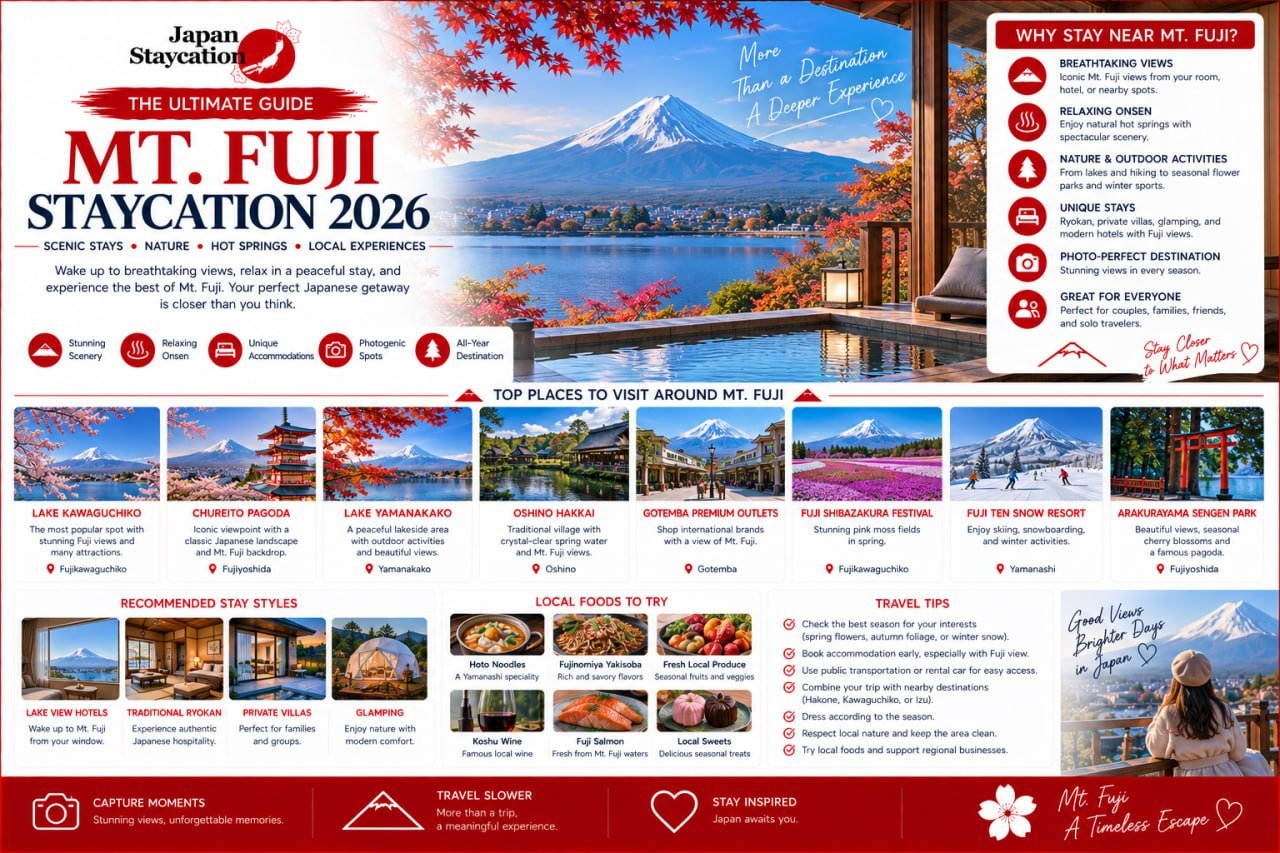
Mt
Fuji Staycation 2026: Kawaguchiko, Hakone & Hot Spring Resorts
Mt Fuji is not just a mountain. It is Japan’s spiritual anchor, a
perfectly symmetrical volcano that has inspired painters, pilgrims, and
poets for over a thousand years. For a 2026 staycation, the Mt Fuji
region offers something unique: the chance to wake up to one of the
world’s most iconic views from your own private accommodation.
This guide covers the two primary Mt Fuji staycation bases—Lake
Kawaguchiko for lakeside tranquility and Hakone for hot spring
luxury—along with practical advice on timing, rentals, and activities
that make this more than just a postcard destination.
Why Base Your Staycation
Near Mt Fuji
The View: No other Japanese staycation destination
offers such an immediate, daily relationship with a single iconic
landscape. On clear mornings, Fuji dominates your window. On cloudy
days, it hides like a shy deity, making every sighting feel earned.
Accessibility: Despite its wilderness atmosphere,
the Mt Fuji region sits only 90-120 minutes from Tokyo by train. You can
have breakfast in Shinjuku and lunch overlooking the lake.
Seasonal Variety: Spring cherry blossoms frame the
mountain. Summer lavender fields carpet the surrounding lowlands. Autumn
maple leaves reflect in the five Fuji lakes. Winter snow caps the peak
against cobalt skies. Each season offers a completely different
Fuji.
Activity Density: Within a 30-kilometer radius, you
can boat on volcanic lakes, hike subalpine forests, soak in mineral hot
springs, visit samurai-era post towns, ride cable cars above clouds, and
tour ancient lava caves. No other region packs so much variety into such
a compact area.
Best Areas for
Your Mt Fuji Staycation Rental
Lake Kawaguchiko: The Classic
View
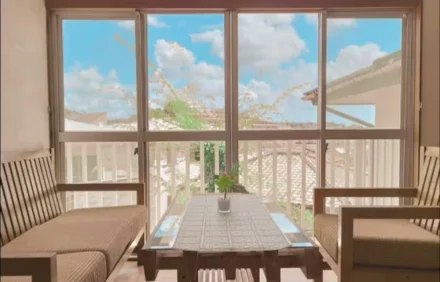
Of the five Fuji lakes, Kawaguchiko offers the best combination of
accommodation options, tourist infrastructure, and unobstructed mountain
views. The northern shore faces Fuji directly, meaning lakeside rentals
wake up to the mountain every morning.
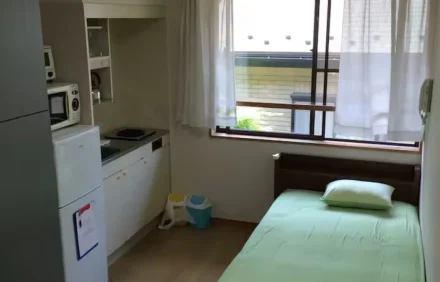
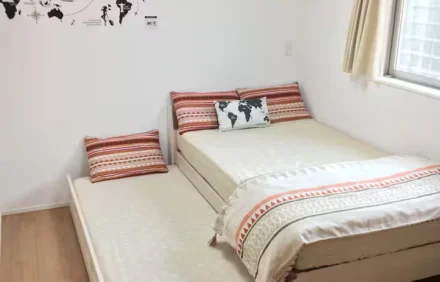
Vacation rental options: – Lakeside apartments and
cottages with Fuji views (USD 100-250 per night) – Traditional
guesthouses with tatami rooms and shared kitchens (USD 70-120 per night)
– Modern glamping pods and cabin resorts (USD 120-200 per night) – Large
group houses suitable for families or friend groups (USD 200-400 per
night)
The town itself is modest—think local restaurants, small
supermarkets, and tourist boat docks rather than nightlife. But that is
precisely the appeal. Kawaguchiko is a place for early mornings, quiet
evenings, and days spent outdoors.
Best for: Photographers, families, nature lovers,
first-time Fuji visitors
Lake Yamanakako: Quieter and
Higher
The largest and highest of the Fuji five lakes, Yamanakako sits at
980 meters elevation and receives fewer tourists than Kawaguchiko. The
views are equally spectacular, but the atmosphere is more residential
and less commercial.
Vacation rental options: – Hillside cottages with
panoramic Fuji views (USD 90-170 per night) – Lakefront cabins with boat
access (USD 100-180 per night) – Ski resort condos (usable year-round,
excellent value) (USD 70-130 per night)
Yamanakako is quieter, cooler in summer, and closer to the Yoshida
Trail trailhead if you are planning a Fuji summit attempt. The trade-off
is fewer restaurants and a slightly longer journey from Tokyo.
Best for: Repeat visitors, hikers, families with
young children, budget-conscious travelers
Hakone: Onsen Luxury
If Kawaguchiko is the view, Hakone is the experience. This volcanic
valley southwest of Mt Fuji is Japan’s most famous hot spring resort,
where ryokan inns have been serving travelers since the Edo period. The
mountain is visible from parts of Hakone, but the emphasis here is on
hot spring bathing, traditional cuisine, and forest tranquility.
Vacation rental options: – Private villas with
open-air onsen baths (USD 200-500 per night) – Guesthouses in converted
traditional farmhouses (USD 120-220 per night) – Modern apartments in
Gora or Hakone-Yumoto (USD 90-160 per night) – Capsule ryokan-style
rooms for solo travelers (USD 60-100 per night)
Hakone is more expensive than the Fuji lakes but offers a level of
service and atmosphere that justifies the premium. Many accommodations
include half-board kaiseki dinners and private bath access.
Best for: Couples, luxury travelers, onsen
enthusiasts, honeymooners
Fujikawaguchiko Town: Local
Living
For longer stays or budget-conscious travelers, the residential areas
between the lake and the main road offer authentic Japanese small-town
living. You will not have the immediate lakeside view, but you will have
local supermarkets, neighborhood sento baths, and lower prices.
Vacation rental options: – Japanese-style apartments
in residential complexes (USD 50-90 per night) – Single-family homes
available for monthly rental (USD 1,500-2,500 per month) – Share houses
with other long-term staycationers (USD 40-70 per night)
Best for: Long-term staycationers, digital nomads,
budget travelers
Top Things to
Do During Your Mt Fuji Staycation
Iconic Views and Photography
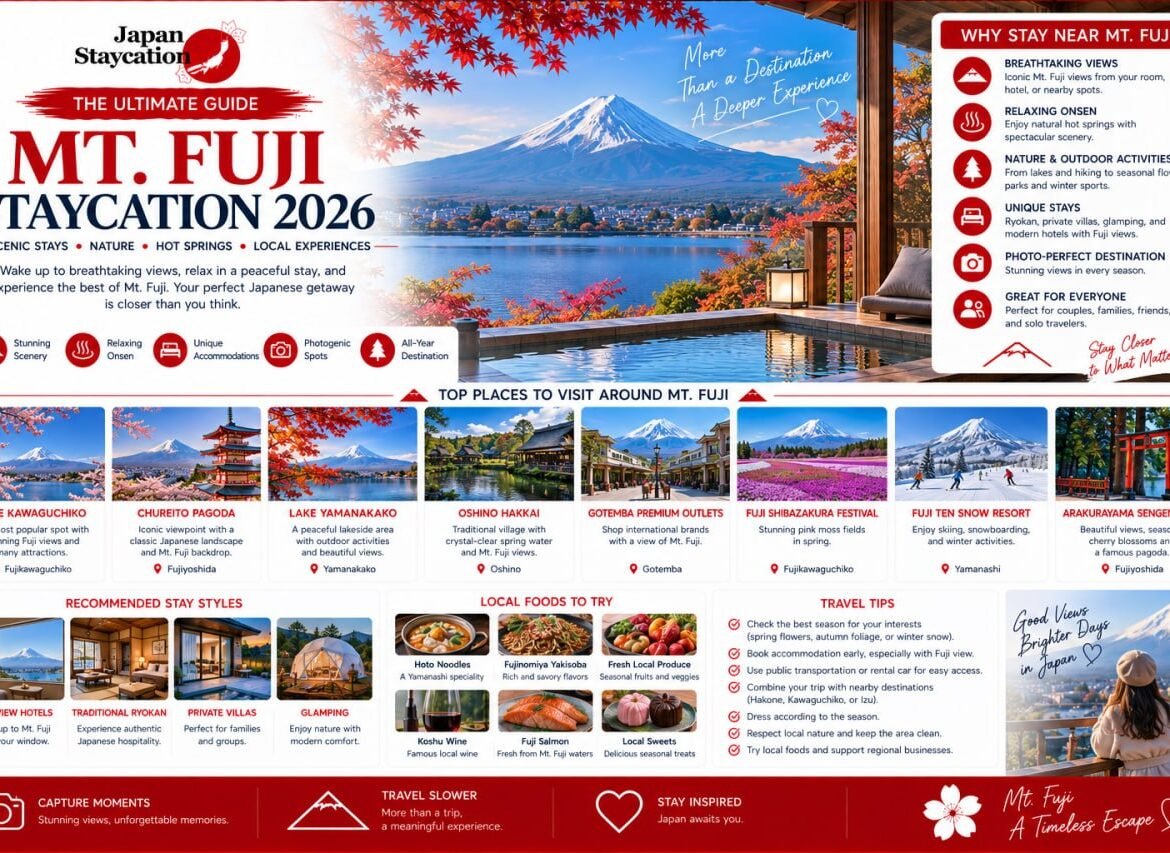
Chureito Pagoda (Arakurayama Sengen Park): The most
photographed view of Mt Fuji—a five-story pagoda framed by cherry
blossoms in spring and the mountain itself. Arrive before 7 AM to avoid
crowds.
Lake Kawaguchiko Northern Shore: The classic
lakeside reflection shot. Rent a bicycle and ride the lakeside path at
sunrise when the water is still.
Oishi Park: Lavender fields in summer, cosmos in
autumn, and year-round lakefront views. Free and accessible.
Mt Fuji Panoramic Ropeway (Tenjoyama): Cable car
ascending to an observation deck with 360-degree views including Fuji
and the Southern Alps. Best visibility in morning.
Hakone Ropeway and Owakudani: Ride above steaming
sulfur vents to an active volcanic valley. On clear days, Fuji appears
above the clouds. Try the legendary black eggs boiled in sulfuric hot
springs.
Outdoor Activities
Fuji Five Lakes Cycling: Rent bicycles (electric
assist available) and cycle the 20-kilometer path connecting
Kawaguchiko, Saiko, and Shojiko. Mostly flat, well-marked, and
stunning.
Aokigahara Forest Hike: The “Sea of Trees” at Fuji’s
northern base is a dense lava forest with natural lava caves (Wind Cave
and Ice Cave). Guided tours recommended for navigation and context.
Kayaking and Paddleboarding: Rent kayaks on Lake
Kawaguchiko for unique water-level views of the mountain. Calmest
conditions are early morning.
Oshino Hakkai Spring Village: Eight crystal-clear
spring pools fed by Mt Fuji’s underground snowmelt, surrounded by
thatched-roof farmhouses. A 15-minute bus ride from Kawaguchiko
Station.
Hakone Ashi Lake Cruise: Pirate ship-themed boats
cruise between Hakone-machi and Moto-Hakino, with Fuji views from the
water. Combine with the ropeway for a full circuit.
Cultural Experiences
Fuji Visitor Center: Free museum explaining Fuji’s
geology, ecology, and cultural significance. Essential context before
any mountain visit.
Kitaguchi-hongu Fuji Sengen Shrine: The traditional
starting point for Yoshida Trail pilgrims for over 500 years. Massive
cedar trees and a solemn atmosphere.
Hakone Open-Air Museum: Japan’s first open-air
museum, combining sculpture gardens with Picasso’s ceramic works and a
foot bath fed by natural hot springs.
Amazake-chaya Tea House: A 400-year-old
thatched-roof teahouse on the Old Tokaido Road serving amazake (sweet
rice drink) to travelers just as it did during the samurai era.
Mt Fuji Summit Attempt
The official climbing season runs from early July to mid-September.
The Yoshida Trail (from the 5th Station) is the most accessible and
takes 5-7 hours up and 3-4 hours down. Night climbing to reach the
summit for sunrise (goraiko) is the classic experience.
Important: Mt Fuji is NOT a casual hike. Altitude
sickness affects many climbers. Proper gear, physical preparation, and
weather monitoring are essential. Do not attempt outside official
climbing season—annual rescues of unprepared climbers are unfortunately
common.
Mt Fuji Region Food Guide
The volcanic soil around Mt Fuji produces distinct cuisine shaped by
altitude and geography.
Hoto Noodles: A hearty flat noodle soup loaded with
vegetables and pumpkin, unique to the Yamanashi Prefecture around Fuji.
Think of it as Japan’s answer to rustic Italian minestrone.
Yoshida Udon: Thick, chewy udon noodles served with
simple toppings of cabbage and miso. Local shops have been making them
the same way for generations.
Freshwater Fish: The Fuji lakes produce excellent
wakasagi (smelt) and iwana (char), often served as tempura or
salt-grilled.
Fujizakura Pork: Locally raised pork used in
tonkatsu and shabu-shabu restaurants around the lakes.
Hakone Tofu: The mineral-rich spring water of Hakone
produces exceptionally smooth tofu, often served as yudofu (hot pot) in
ryokan dinners.
Budget Meals (USD 8-15) – Kawaguchiko Station-area
noodle shops – Convenience store onigiri and snacks – Supermarket deli
sections (excellent prepared foods after 6 PM discounts)
Mid-Range Dining (USD 20-40) – Hoto restaurants near
the lake – Yoshida udon specialty shops – Hakone’s casual soba and udon
restaurants
Splurge Experiences (USD 80+) – Ryokan kaiseki
dinners in Hakone – Private lakeside dining at luxury accommodations –
Craft beer tasting at local breweries (Fujizakura Heights Beer,
Kawaguchiko Brewery)
Getting Around the Mt Fuji
Region
From Tokyo: The Fujikyuko Bus from Shinjuku Station
takes 1 hour 45 minutes to Kawaguchiko (USD 20). The JR Azusa or Kaiji
limited express trains go to Otsuki, where you transfer to the Fujikyuko
Line (total 2-2.5 hours, USD 25-30).
Hakone Freepass: A 2- or 3-day pass covering
Hakone’s buses, trains, ropeways, and pirate ship cruises (USD 50-65).
Essential for Hakone exploration.
Bus: Regular buses connect Kawaguchiko, Yamanakako,
Saiko, and the surrounding attractions. The “Retro Bus” and “Blue Line”
services are designed for tourists.
Rental Car: Useful for visiting multiple lakes in
one day or reaching trailheads. Roads are well-maintained but winding.
International Driving Permit required.
Bicycle: The most rewarding way to explore the
Kawaguchiko area. Electric-assist bikes make the gentle hills
effortless. Rentals available at multiple shops near the station.
Budget
Breakdown for a 1-Week Mt Fuji Staycation
| Expense Category | Budget (USD) | Mid-Range (USD) | Luxury (USD) |
|---|---|---|---|
| Accommodation (7 nights) | 350-630 | 700-1,400 | 1,960+ |
| Food (7 days) | 140-210 | 280-420 | 700+ |
| Transportation | 40-80 | 80-150 | 300+ |
| Activities & Passes | 60-120 | 150-300 | 600+ |
| Total per person | 590-1,040 | 1,210-2,270 | 3,560+ |
Note: Summit attempts add approximately USD 50-100 for mountain hut
accommodation and gear rental. Hakone ryokan stays significantly
increase accommodation costs but include elaborate dinner and
breakfast.
Mt Fuji Visibility: Timing
Your Stay
Mt Fuji is notoriously shy. The mountain is fully visible on only
about 100 days per year, with summer being the worst season for
visibility due to haze and cloud formation.
Best visibility months: December-February (winter
clarity) and October-November (autumn dry air) Worst visibility
months: July-August (cloudy season, though these are the only
months for summit climbing) Best time of day: Early
morning (6-9 AM) before afternoon clouds form
Pro tip: Book a minimum 3-night stay. This gives you
multiple morning chances to see the mountain. Staying one night and
missing the view due to clouds is a common disappointment.
Sample 7-Day Mt Fuji
Staycation Itinerary
Day 1: Travel from Tokyo to Kawaguchiko. Settle into
lakeside rental. Evening lakeside walk and local noodle dinner.
Day 2: Sunrise Fuji viewing from Oishi Park. Morning
kayak or paddleboard. Afternoon cycling to Lake Saiko and Aokigahara
Forest. Evening hot spring at local onsen.
Day 3: Chureito Pagoda early morning for iconic
photos. Afternoon visit to Oshino Hakkai spring village. Evening craft
beer tasting.
Day 4: Travel to Hakone (1.5 hours by bus or train).
Check into ryokan or private villa. Evening kaiseki dinner and private
onsen soak.
Day 5: Hakone circuit—ropeway to Owakudani, pirate
ship cruise on Lake Ashi, Hakone Shrine. Afternoon at Hakone Open-Air
Museum. Evening second onsen.
Day 6: Return to Kawaguchiko or extend in Hakone.
Optional: visit Fujisan World Heritage Center or samurai post town of
Mishima.
Day 7: Final morning Fuji viewing. Departure to
Tokyo or onward travel.
Practical Staycation Tips
Weather: Mountain weather changes rapidly. Pack
layers even in summer. Winter temperatures near Fuji drop well below
freezing.
Altitude: If arriving directly from sea level, take
the first day easy. The 800+ meter elevation of the lakes can cause mild
altitude symptoms for sensitive individuals.
Cash: Many small restaurants and shops around the
lakes do not accept credit cards. Carry sufficient cash.
WiFi: Most vacation rentals include pocket WiFi,
important because mobile signal can be weak in valleys and forested
areas.
Language: English is limited outside major hotels
and tourist centers. Google Translate with camera function helps
enormously for restaurant menus.
Booking: July-August and October foliage season are
extremely busy. Book accommodations 2-3 months ahead. Winter
(January-February) offers lower prices and better visibility but fewer
open restaurants.
Final Thoughts
Mt Fuji is not a sight to be checked off. It is a presence to be
lived with. The best staycation experiences here happen not when you are
actively sightseeing, but when you are cooking breakfast in your rental
kitchen and glance up to see the mountain catching dawn light through
the window.
Give the mountain time. Stay multiple mornings. Let it hide and
reveal itself. That is how Mt Fuji becomes more than a photograph—it
becomes a memory that stays with you long after you leave.
Planning your Mt Fuji staycation? Browse our curated vacation
rentals in Kawaguchiko, Yamanakako, and Hakone to find your perfect base
for Japan’s most iconic view.
Author: Ayana Sugiwara Published:
September 2026 Category: Japan Staycation Guides