Ikebukuro vs Shibuya vs Asakusa: Where to Rent in Tokyo 2026
Ikebukuro vs Shibuya vs Asakusa: Where to Rent in Tokyo 2026
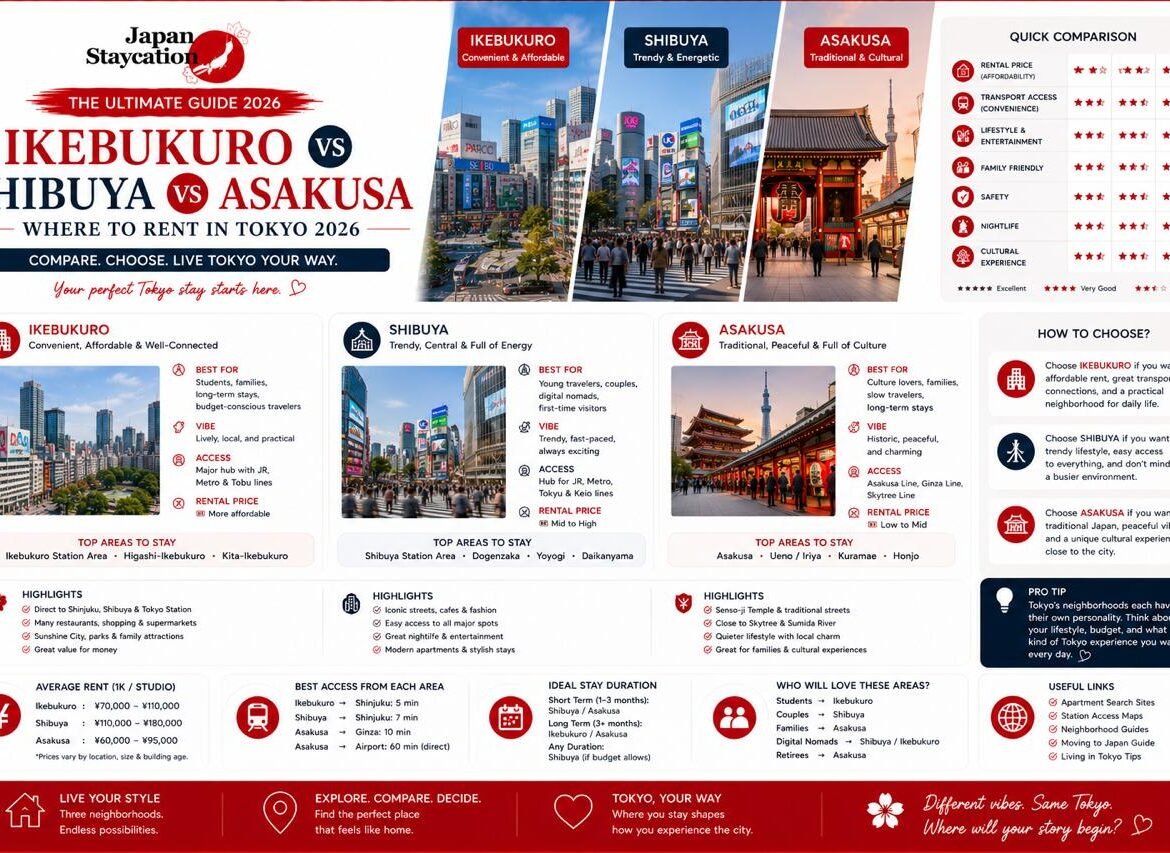
Tokyo has over 20 central neighborhoods that foreigners consider for monthly rentals and extended stays. Three districts consistently rise to the top of every search: Ikebukuro, Shibuya, and Asakusa. Each attracts a completely different type of resident. This comparison breaks down rent prices, lifestyle, commute access, and daily conveniences so you can choose the right neighborhood for your 2026 Tokyo stay.
Why These Three Neighborhoods Dominate Foreigner Searches
Ask any foreigner who has lived in Tokyo for more than a month, and they will mention at least one of these three areas. Ikebukuro draws budget-conscious residents and anime fans. Shibuya attracts young professionals and creatives who want energy at their doorstep. Asakusa appeals to those who prefer traditional Tokyo over neon towers.
The differences are not just aesthetic. Your daily commute, grocery bills, and social life will look completely different depending on which district you choose.
Side-by-Side Comparison: Ikebukuro vs Shibuya vs Asakusa
| Factor | Ikebukuro | Shibuya | Asakusa |
|---|---|---|---|
| Monthly Rent (1K) | ¥95,000 – ¥140,000 | ¥130,000 – ¥200,000 | ¥85,000 – ¥125,000 |
| Station Lines | JR Yamanote, Marunouchi, Yurakucho, Fukutoshin | JR Yamanote, Hanzomon, Ginza, Fukutoshin | Asakusa Line, Ginza Line, Tobu Skytree |
| Commute to Shinjuku | 5 min direct | 7 min direct | 18 min (1 transfer) |
| Commute to Tokyo Station | 15 min | 12 min | 10 min direct (Asakusa Line) |
| Supermarket Density | High (Seiyu, Tobu Store, Don Quijote) | Medium (higher prices) | Low (more local grocers) |
| English Support | Good (Otome Road has bilingual signage) | Excellent (banks, clinics, agencies) | Limited (tourist-level only) |
| Nightlife Style | Game centers, karaoke, izakayas | Clubs, live music, rooftop bars | Traditional izakayas, river walks |
| Apartment Age | Mix of 1980s and 2010s+ | Newer towers but smaller units | Older stock, more spacious |
| Best For | Budget renters, students, anime workers | Professionals, creatives, short-term | Cultural explorers, families, long stays |
Ikebukuro: The Budget Powerhouse
Ikebukuro is the only neighborhood on this list where you can find a clean 1K apartment under ¥100,000 per month within a 10-minute walk of a Yamanote Line station. That alone makes it the default choice for students, first-time Tokyo residents, and anyone whose employer does not cover housing.
What ¥100,000 Gets You in Ikebukuro
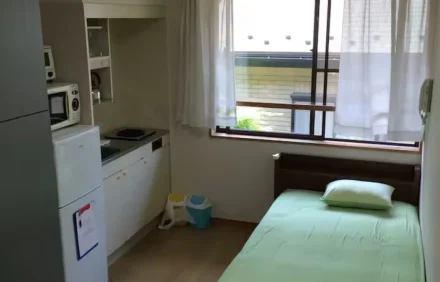
A typical 1K at this price point will be 18–23 square meters, built between 1985 and 2005, and located within 8 minutes of Ikebukuro Station. Expect a compact unit bath, a two-burner kitchen, and enough closet space for a single person. Buildings are rarely luxurious, but they are functional and well-maintained.
Who Thrives in Ikebukuro
- Students at nearby universities (Waseda, Tokyo University of Foreign Studies)
- Remote workers who need fast internet and low rent
- Anime and gaming industry professionals working in Otome Road studios
- First-year expats who want to minimize move-in costs
The Trade-Offs
Ikebukuro is not pretty. The east side of the station can feel crowded and gritty after dark. Street noise is constant. And while the Yamanote Line is unbeatable, the platform at rush hour is genuinely unpleasant. If you are sensitive to crowds, look at Mejiro or Takadanobaba instead — same line, calmer atmosphere.
Shibuya: Central Tokyo at a Premium
Shibuya is the neighborhood everyone pictures when they think of Tokyo. The crossing, the towers, the packed streets. Living here means paying for access, not for space. A 20-square-meter 1K near Shibuya Station costs roughly what a 30-square-meter 1DK costs in Ikebukuro.
What ¥160,000 Gets You in Shibuya
Your ¥160,000 typically buys a 1K of 18–25 square meters in a building from the 2000s or newer. The unit will have a modern bathroom, reliable plumbing, and probably a delivery box. Some towers have gyms and lounges. You are paying ¥60,000 more than Ikebukuro for the same square footage, but you are walking distance from coworking spaces, bilingual clinics, and international grocery stores.
Who Thrives in Shibuya
- Professionals at startups or international firms with offices in Shibuya or Aoyama
- Short-term residents (3–6 months) who prioritize location over savings
- Nightlife enthusiasts who want to walk home from bars
- Content creators who need a central base for shoots across Tokyo
The Trade-Offs
Noise is the biggest complaint. Even residential side streets like Tomigaya are loud on weekends. Construction is endless. And the social pressure to go out every night can drain both your energy and your budget. Shibuya is exciting for three months. After six, many residents move to Sangenjaya or Nakameguro for the same vibe at lower cost.
Asakusa: Old Tokyo for Patient Residents
Asakusa is the outlier in this comparison. It is not on the Yamanote Line. It does not have Shibuya’s energy or Ikebukuro’s convenience. What it offers is atmosphere: temples, traditional festivals, river walks, and a community that still greets neighbors.
What ¥90,000 Gets You in Asakusa
At ¥90,000, you can find a 25–32 square meter 1DK in a 1970s or 1980s building. The apartment will feel dated. The kitchen may use gas instead of IH. But you will have actual living space, something impossible in Shibuya at any reasonable price. Many buildings are walk-ups without elevators, which is worth confirming before signing.
Who Thrives in Asakusa
- Long-term residents who want a stable neighborhood
- Families with children (more parks, fewer late-night venues)
- Cultural enthusiasts who value temples and traditional crafts
- Remote workers who do not need daily Yamanote access
The Trade-Offs
The Asakusa Line connects to Narita Airport and Nihonbashi but does not serve Shinjuku or Shibuya directly. You will transfer more often. English support is limited outside tourist areas. And the area is quiet by 9 PM, which is either a benefit or a drawback depending on your lifestyle.
Commute Reality Check: Where Do You Actually Need to Go?
Before choosing a neighborhood, map your actual weekly destinations. Here is how each area performs:
| Destination | From Ikebukuro | From Shibuya | From Asakusa |
|---|---|---|---|
| Shinjuku | 5 min direct | 7 min direct | 18 min (1 transfer) |
| Tokyo Station | 15 min | 12 min | 10 min direct |
| Shinagawa | 25 min | 20 min | 28 min |
| Roppongi | 18 min | 10 min | 22 min |
| Narita Airport | 60 min | 55 min | 50 min direct |
| Disneyland | 50 min | 45 min | 30 min direct |
Asakusa wins for airport access and Disneyland. Shibuya wins for Roppongi and central Tokyo. Ikebukuro wins for Shinjuku and north Tokyo.
Hidden Costs Beyond Monthly Rent
Base rent is only part of the story. Here is what each neighborhood adds to your real monthly cost:
| Cost Category | Ikebukuro | Shibuya | Asakusa |
|---|---|---|---|
| Groceries (monthly) | ¥35,000 | ¥42,000 | ¥32,000 |
| Transport (commute) | ¥0 (usually covered by rent savings) | ¥0 | ¥8,000 (more transfers) |
| Entertainment | ¥20,000 | ¥45,000 | ¥12,000 |
| Utilities | ¥12,000 | ¥12,000 | ¥14,000 (older buildings) |
| Real Monthly Cost | ¥162,000 | ¥259,000 | ¥151,000 |
At ¥95,000 base rent, Ikebukuro’s real monthly cost is ¥162,000. Shibuya at ¥160,000 base rent pushes your real cost past ¥250,000. Asakusa is cheapest overall despite less convenient transit.
Decision Framework: Which Neighborhood Fits You?
Answer these questions honestly:
- Is your company paying rent? If yes, Shibuya. If no, Ikebukuro or Asakusa.
- Do you need daily Yamanote Line access? If yes, Ikebukuro or Shibuya. Asakusa requires transfers.
- Do you work from home? If yes, Asakusa gives you the most space per yen.
- Is nightlife important? Shibuya wins. Asakusa closes early. Ikebukuro is somewhere in between.
- Are you staying longer than six months? Asakusa’s lower rent and calmer pace pay off over time.
Final Recommendation by Profile
| Profile | Best Choice | Runner-Up |
|---|---|---|
| First-year expat, self-funded | Ikebukuro | Asakusa |
| Short-term (3 months), company-funded | Shibuya | Shibuya (no contest) |
| Remote worker, long-term | Asakusa | Ikebukuro |
| Nightlife professional | Shibuya | Ikebukuro |
| Family with young children | Asakusa | Ikebukuro |
| Student or intern | Ikebukuro | Asakusa |
What to Do Next
Once you have chosen your neighborhood, read our detailed area guides:
- Apartment for Rent in Shibuya Tokyo 2026: Complete Guide for Foreigners
- Apartment for Rent in Ikebukuro Tokyo 2026: Complete Guide for Foreigners
- Apartment for Rent in Asakusa Tokyo 2026: Complete Guide for Foreigners
Ready to book? Browse current Tokyo apartment listings and filter by neighborhood, budget, and contract type.