Setagaya Share House Guide 2026: Budget Accommodation in Tokyo
What Is a Setagaya Share House
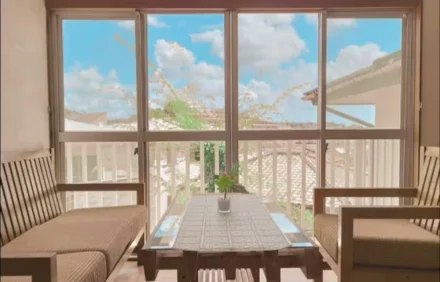
A share house in Setagaya offers private bedrooms within a communal living space, making it one of Tokyos most budget-friendly accommodation options. Unlike hostels, Setagaya share houses cater to longer stays typically one month to one year and provide a more home-like environment with shared kitchens, living rooms, and sometimes rooftop terraces. They are especially popular among students, young professionals, and digital nomads seeking community and affordability.
Why Choose Setagaya for Share House Living
Setagaya is Tokyos most populous ward and consistently ranks as one of the most desirable places to live. Share houses here offer significantly lower rents than central Tokyo while maintaining excellent connections to Shibuya, Shinjuku, and Yokohama. The neighborhoods relaxed atmosphere, abundant parks, and trendy cafe culture make it ideal for long-term residents who want to experience authentic Tokyo life without the premium price tag.
Costs of Setagaya Share Houses
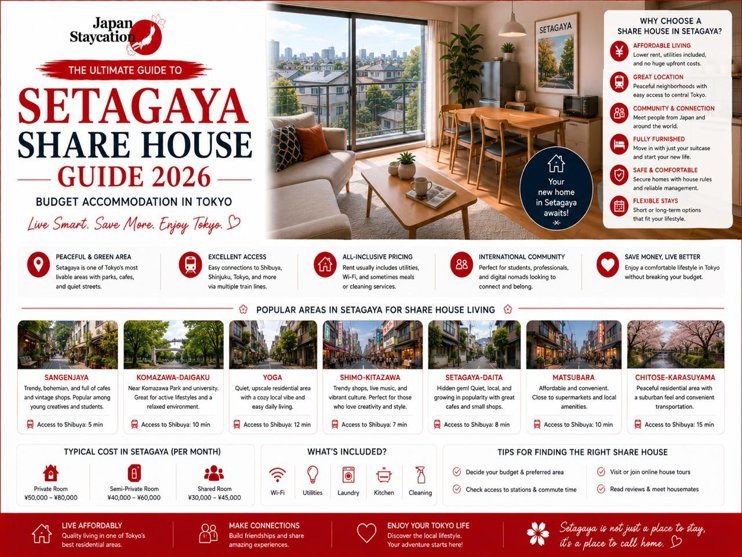
Monthly rent for a Setagaya share house typically ranges from JPY 45,000 to JPY 80,000, depending on room size, location, and included amenities. Most share houses charge a one-time deposit of JPY 20,000-30,000 and a nominal utilities fee of JPY 10,000-15,000 per month. Compared to renting a private apartment in Setagaya (JPY 80,000-150,000), share houses offer savings of 30-50 percent.
Types of Share Houses in Setagaya
International Share Houses: Designed for foreigners with English-speaking managers, multilingual housemates, and cultural exchange events. These are the most popular among international visitors.
Women-Only Share Houses: Secure, comfortable environments exclusively for female residents, often featuring enhanced security systems and female-oriented amenities.
Designer Share Houses: Recently renovated properties with stylish interiors, often converted from traditional Japanese homes. These cost slightly more but offer unique living experiences.
Family Share Houses: Larger properties with family-sized rooms and child-friendly common areas. Less common but increasingly available in suburban Setagaya.
What Is Included in a Setagaya Share House
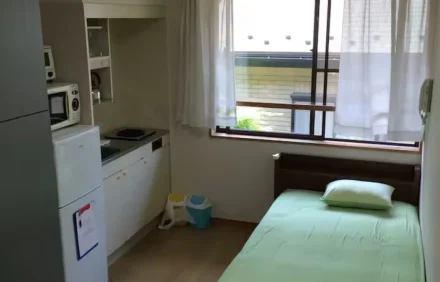
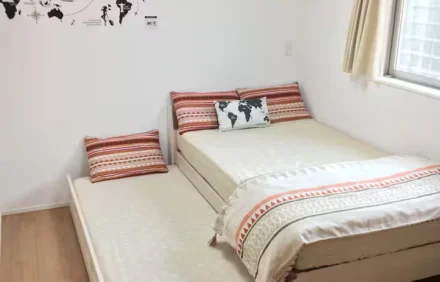
Most Setagaya share houses include fully furnished private rooms (bed, desk, closet), shared kitchen appliances, washing machines, high-speed internet, and basic living supplies like toilet paper and cleaning products. Some premium share houses add services like weekly cleaning, bicycle rentals, and organized social events. Always confirm what is included before signing a contract.
How to Apply for a Setagaya Share House
Applying is straightforward. Most share house operators accept online applications with just a passport copy and basic personal information. Unlike traditional Japanese rentals, share houses rarely require a guarantor or key money. Approval is typically granted within 2-3 business days, and move-in can happen as soon as the room is ready. English-speaking staff are common at international-oriented properties.
Life in a Setagaya Share House: What to Expect
Living in a Setagaya share house means embracing communal living. You will cook alongside housemates from around the world, share Netflix accounts, and possibly join weekend group outings to local izakayas. Most houses establish quiet hours (typically 11 PM to 7 AM) and chore rotation schedules. Respect, cleanliness, and communication are the golden rules.
FAQ About Setagaya Share Houses
Can I stay short-term in a share house? Most require minimum stays of one month, though some offer weekly rates at a premium.
Are share houses safe? Yes, reputable operators conduct background checks and provide secure entry systems.
Can couples stay in a share house? Some allow couples in larger rooms, but most prioritize single occupants to maintain room availability.
Do share houses allow pets? Almost never. Pet-friendly share houses are extremely rare in Tokyo.
Is English spoken in Setagaya share houses? At international share houses, yes. Staff and many residents communicate in English.
Last updated: August 2026