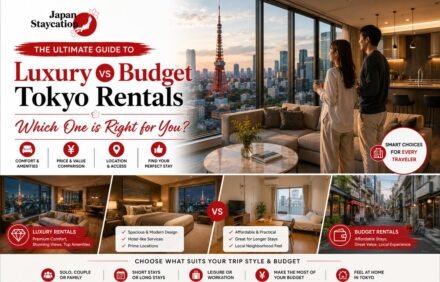
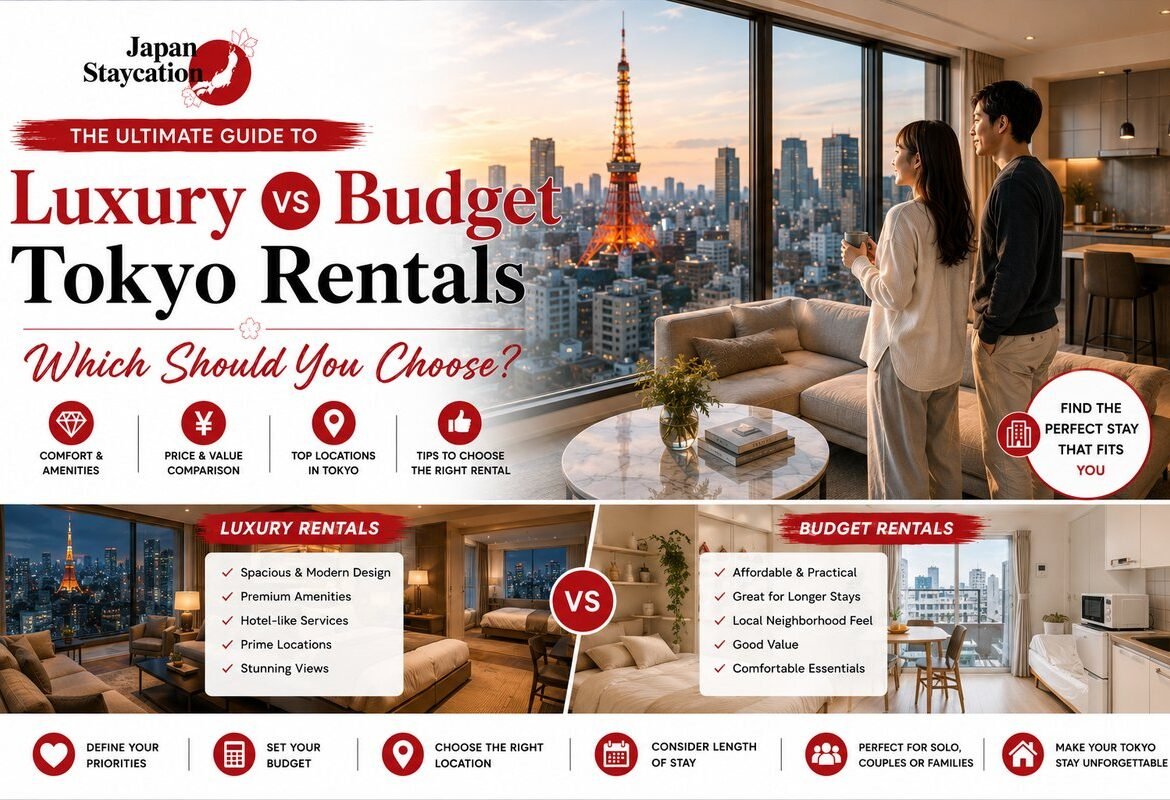
Luxury vs Budget Tokyo Rentals: Complete Comparison Guide
Choosing accommodation in Tokyo involves more than finding a place to sleep — it fundamentally shapes your experience of one of the world’s most exciting cities. The question of luxury vs budget tokyo rentals perplexes even seasoned travelers, as the definition of “luxury” and “budget” varies dramatically across Tokyo’s diverse neighborhoods and rental markets.
This comprehensive guide cuts through the confusion with real price data, honest comparisons, and practical recommendations tailored to different traveler profiles. Whether you are planning a week-long family staycation or a month-long remote work adventure, understanding the true trade-offs between luxury and budget rentals will help you maximize both your yen and your Tokyo experience.
Price Comparison: What You Actually Pay
The price gap between luxury and budget Tokyo rentals extends far beyond the nightly rate. Understanding the complete cost picture helps explain why a seemingly “expensive” luxury rental might actually deliver better value than a budget option when all factors are considered.
Average Nightly Rates (2026 Data):
| Rental Type | Min Rate/Night | Max Rate/Night | Average/Night |
|---|---|---|---|
| Budget Studio (15-25 sqm) | ¥5,000 | ¥10,000 | ¥7,500 |
| Budget 1BR (30-45 sqm) | ¥8,000 | ¥15,000 | ¥11,500 |
| Mid-Range 1-2BR (50-70 sqm) | ¥15,000 | ¥30,000 | ¥22,500 |
| Luxury 1-2BR (70-100 sqm) | ¥35,000 | ¥70,000 | ¥52,500 |
| Ultra-Luxury Penthouse (120+ sqm) | ¥80,000 | ¥250,000 | ¥165,000 |
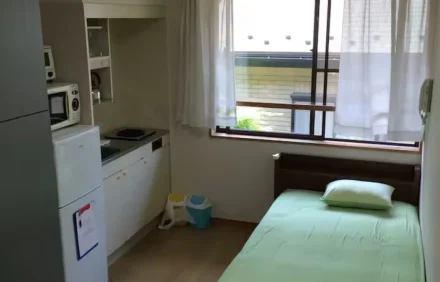
Important context: Budget rentals in Tokyo are typically smaller than their international equivalents. A 25-square-meter studio is standard for budget tier, while luxury rentals offer space comparable to Western apartments.
Weekly and Monthly Discounts:
- Budget rentals: Often offer 10-15% weekly discounts, 20-30% monthly discounts
- Luxury rentals: Typically provide 15-25% weekly discounts, 35-50% monthly discounts
- Peak seasons (cherry blossom, Golden Week, New Year) see 20-40% price premiums across all tiers
Amenities: Luxury vs Budget
The amenities gap between luxury vs budget tokyo rentals extends beyond surface-level comforts to fundamentally different living experiences. Understanding these differences helps set realistic expectations.
Budget Rental Standard Amenities:
- Compact kitchenette: Single burner, mini fridge, basic utensils
- Combined bath/toilet: Unit bathroom (unit bath) common in Japanese apartments
- Portable WiFi or shared internet: Often slower speeds (20-50 Mbps)
- Washing machine: Typically located in bathroom or shared space
- Air conditioning: Single wall unit, heating and cooling
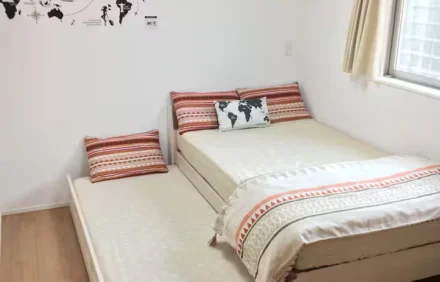
- Futon or compact bed: Semi-double (120cm) to double (140cm) width common
- Basic towels and linens: Usually provided but minimal
Luxury Rental Standard Amenities:
- Full kitchen: Multiple burners, full-size refrigerator, dishwasher, quality cookware
- Separate bath and toilet: Often with bathtub and rain shower
- High-speed fiber internet: 500 Mbps to 1 Gbps dedicated connection
- In-unit washer/dryer: Separate machines, sometimes with steam function
- Central climate control: Individual room temperature control
- Queen or king-size bed: Premium mattresses with quality linens
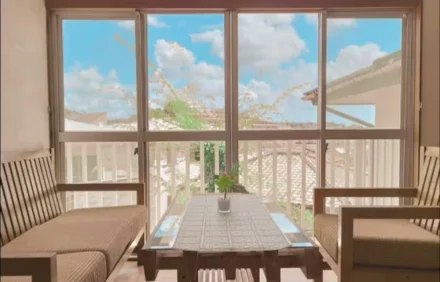
- Balcony or terrace: Outdoor space with city views
- Building amenities: Gym, lounge, concierge, security (in tower buildings)
Location Breakdown by Budget
Location significantly impacts both price and experience in Tokyo. The following breakdown reveals which neighborhoods offer the best value at each price point.
| Neighborhood | Best For | Budget Range | Why Choose Here |
|---|---|---|---|
| Asakusa | Culture & Traditional Tokyo | Budget to Mid | Authentic atmosphere, lower prices, great food scene |
| Shibuya | Youth Culture & Nightlife | Mid to Luxury | Transportation hub, endless dining, vibrant energy |
| Shinjuku | Business & Entertainment | Mid to Luxury | Major station, skyscrapers, red-light district (Kabukicho) |
| Ginza/Marunouchi | Luxury Shopping & Dining | Luxury only | Tokyo’s most prestigious address, world-class amenities |
| Nakameguro/Daikanyama | Trendy & Residential | Mid to Luxury | Stylish cafes, boutique shops, cherry blossom canal |
| Ikebukuro | Budget-Friendly Transport | Budget to Mid | Major hub, cheaper rents, anime culture |
Pros and Cons Table
When evaluating luxury vs budget tokyo rentals, consider these comprehensive pros and cons:
| Factor | Budget Rentals | Luxury Rentals |
|---|---|---|
| Price | ✅ Significantly cheaper, more money for experiences | ❌ Expensive, limits budget for other activities |
| Space | ❌ Cramped, minimal storage, may feel claustrophobic | ✅ Generous space, comfortable for extended stays |
| Location Quality | ⚠️ Often farther from stations or in less desirable areas | ✅ Prime locations near major stations and attractions |
| Comfort | ❌ Basic furnishings, older buildings, potential noise issues | ✅ Premium furnishings, modern buildings, soundproofed |
| Local Experience | ✅ Authentic residential neighborhoods, daily life immersion | ⚠️ Tourist-oriented buildings, less neighborhood integration |
| Self-Catering | ⚠️ Tiny kitchenettes limit cooking options | ✅ Full kitchens enable significant meal cost savings |
| Work-Friendly | ❌ Limited workspace, slower internet | ✅ Dedicated work areas, fast reliable internet |
| Family Suitability | ❌ Too small for families, no separate spaces | ✅ Multiple bedrooms, family-friendly amenities |
Recommendations by Traveler Type
The optimal choice in the luxury vs budget tokyo rentals debate depends entirely on who is traveling and why:
Solo Traveler (3-7 Nights):
Recommendation: Budget studio in Shibuya, Shinjuku, or Asakusa
Solo travelers spend minimal time in their accommodation. A clean, well-located budget studio provides everything needed while maximizing funds for dining, shopping, and experiences. Look for places with portable WiFi and a convenience store within 2 minutes walk.
Couple (Romantic Staycation, 5-10 Nights):
Recommendation: Mid-range 1BR in Nakameguro, Daikanyama, or near Tokyo Station
Couples benefit from a separate bedroom and living space. Mid-range options in stylish neighborhoods provide romantic canal walks, excellent date-night restaurants, and space to relax together without breaking the bank.
Family with Children (7-14 Nights):
Recommendation: Luxury 2BR in Shinjuku, Tokyo Station area, or Roppongi
Families need space, laundry facilities, and locations near major transit for day trips. Luxury rentals with multiple rooms allow parents to relax after children sleep. The higher cost is offset by savings on eating out (full kitchen) and convenience (in-unit laundry).
Remote Worker / Digital Nomad (30+ Nights):
Recommendation: Mid-range to luxury 1BR in Ebisu, Meguro, or Omotesando
Extended stays demand reliable internet, comfortable workspaces, and enough space to avoid cabin fever. Monthly discounts make luxury options surprisingly competitive, and the productivity benefits of a proper desk and fast internet justify the premium.
Luxury Seeker (Special Occasion, 3-5 Nights):
Recommendation: Ultra-luxury in Ginza, Roppongi Hills, or Azabu-Juban
For honeymoons, anniversaries, or milestone celebrations, Tokyo’s ultra-luxury rentals deliver once-in-a-lifetime experiences. Concierge services, panoramic views, and access to exclusive restaurants create unforgettable memories.
Budget Backpacker (14+ Nights):
Recommendation: Budget studio in Ikebukuro, Ueno, or Asakusa
Tokyo’s most affordable neighborhoods still offer excellent train connections to major attractions. With a rail pass and a basic but clean apartment, backpackers can experience Tokyo thoroughly on minimal funds.
Hidden Costs to Watch For
When comparing luxury vs budget tokyo rentals, hidden costs can significantly alter the true price difference:
- Cleaning Fees: Budget rentals often charge ¥3,000-8,000 per stay; luxury rentals may include cleaning or charge ¥10,000-20,000
- Utility Charges: Some budget rentals bill electricity separately (¥300-800/day in summer/winter); luxury rentals typically include utilities
- Internet Fees: Budget rentals sometimes charge for premium WiFi; luxury rentals include high-speed internet
- Early Check-in/Late Check-out: Budget rentals rarely accommodate; luxury rentals often provide luggage storage and flexible times
- Transportation: Staying farther from stations saves on rent but adds ¥500-1,500 daily in train fares
- Grocery Costs: Luxury rentals with full kitchens save ¥3,000-8,000 daily on restaurant meals
- Laundry: Budget rentals may require coin laundries (¥400-600/load); luxury rentals have in-unit machines
- Resort/Hotel Taxes: Some luxury buildings charge monthly facility fees of ¥5,000-15,000
True Cost Calculation: A ¥7,500/night budget studio with separate cleaning fees, utility charges, and daily restaurant meals often costs similar to a ¥22,500/night mid-range rental with included amenities and kitchen cooking.
Frequently Asked Questions
Is it worth paying for a luxury rental in Tokyo?
For stays longer than 5 nights, families, or remote workers, luxury rentals often deliver superior value when total costs are calculated. The combination of space, included amenities, kitchen facilities, and prime locations eliminates many hidden expenses associated with budget options. However, for solo travelers or those spending minimal time in their accommodation, budget rentals provide excellent value and a more authentic local experience.
How far in advance should I book Tokyo rentals?
Book luxury rentals at least 2-3 months in advance, especially during peak seasons (cherry blossom in late March to early April, Golden Week in late April to early May, and New Year in late December to early January). Budget rentals have more availability but still benefit from 1-month advance booking. Last-minute deals sometimes appear 1-2 weeks before arrival, but this is risky during peak periods when Tokyo accommodation reaches 95%+ occupancy.
Are Tokyo vacation rentals legal and safe?
Yes, vacation rentals in Tokyo operate legally under Japan’s minpaku (private lodging) law, which requires hosts to register with local authorities and display their registration number. Licensed properties meet fire safety and building code requirements. Reputable booking platforms verify registrations. However, some unlicensed rentals still exist — always verify the minpaku registration number before booking. Safety standards in licensed properties are comparable to hotels.
What is the minimum stay requirement for Tokyo rentals?
Budget rentals typically require minimum stays of 2-3 nights. Luxury rentals often have 3-7 night minimums, though some high-end properties accept shorter stays at premium rates. Monthly rentals (30+ nights) receive the deepest discounts and are popular among remote workers and extended-stay travelers. Some platforms offer weekly rates that bridge the gap between short and long stays. Always check minimum stay requirements before making travel plans, as they vary significantly by property and season.
Can I negotiate rental prices in Tokyo?
Direct price negotiation is uncommon for short-term vacation rentals, but several strategies can reduce costs. Booking for longer durations (weekly or monthly) often triggers automatic discounts of 20-50%. Contacting hosts directly through platforms may yield special offers for last-minute bookings or extended stays. Off-season travel (July-August, excluding Obon; January-February) sees significant price reductions. Some hosts offer returning guest discounts or referral bonuses. For luxury rentals, concierge services can sometimes arrange complimentary upgrades or additional amenities.
The luxury vs budget tokyo rentals decision ultimately depends on your travel style, duration, and priorities. Tokyo offers exceptional experiences at every price point — what matters most is choosing accommodation that enhances your journey rather than constraining it. Whether you opt for a cozy budget studio in a traditional neighborhood or a gleaming luxury tower with skyline views, Tokyo will exceed every expectation.